
Freshwater Angelfish Care: Proven Tips from 37 Years of Experience
Angelfish (Pterophyllum scalare) are more than just an aquarium fish. They’re long fins, beautiful colors, and pleasing personalities. Here you’ll explore what makes them an awesome addition to your community tank.
Here is a selection of the most beautiful Angelfish for sale on eBay. Easy to view the Angels – opens in a new window or tab.
Key Takeaways for Angelfish Care (I.E. What you’ll find here):
* I’ve answered 8 FAQ’s like “How much do Angelfish cost?”
* I’ve provided an easy to understand chart giving care requirements.
* I’ve provided a list of Angelfish colors including, “Blushing, Blue, and wild caught.
* I cover behavior and mention a few possible tankmates including Discus Fish, other Angelfish, and Bristlenose Plecos.
* I’ll cover how to successfully breed Angelfish.
Frequently Asked Questions (FAQ)
1. Are Angelfish hard to care for?
No, not hard to care for. They are relatively easy. The key is consistency: don’t overfeed and perform at least 25% water change weekly.
2. How many angelfish should be kept together?
A single angelfish will do fine on its own. However, if you want them to display their natural social behaviors, you should keep them in a group of at least six. This requires a large tank; a 75-gallon tank (minimum) is recommended for a group of this size.
Note on Groups: A group of male only angelfish is often the calmest. When you locate a female either move her to a different tank or give her to your local fish store (recommended). This is because breeding angels are aggressive and will chase the other fish when they have laid eggs.
3. How can I tell if my Angelfish is stressed?
Stressed fish will often show signs like rapid gill movement, loss of color, refusal to eat, and hiding. You will need to identify and correct the underlying problem (e.g., poor water quality, bullying, or incorrect temperature).
4. What kind of water do Angelfish need?
They are highly tolerant of various water types, from hard to soft. As long as the temperature is correct and there is no ammonia or nitrite, they will be happy.
5. How long do Angelfish live in an aquarium?
In theory, they can live from 8 to 12 years if provided with excellent care.
6. How much do angelfish cost?
Prices vary significantly by strain and source. At a big-box store, you might spend $11.49 to about $63.99. Online or from specialty breeders, prices can range from $9.95 for common strains and up to $200 for rare or wild-caught individuals.
Rare and expensive Angelfish for sale on eBay. Opens in a new tab.
7. What temperature should I keep my Angelfish at in Celsius?
24°C to 30°C
8. Are Angelfish good fish for beginners?
Well kind of. If the water is changed 25% weekly and you don’t over stock your aquarium a beginner would be ok keeping Angelfish.
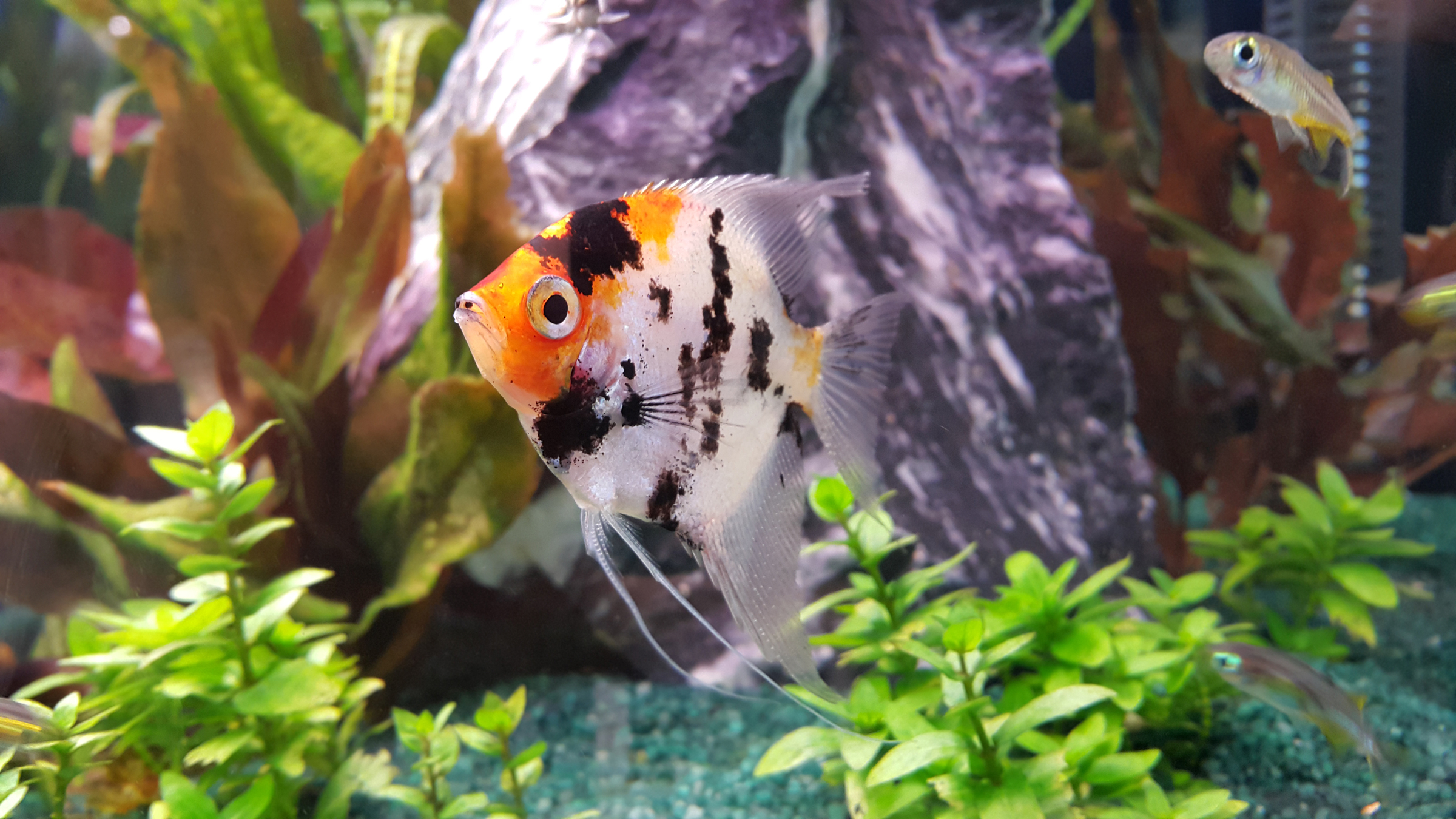
About the image above or below – You can use this image on your website, if you link back to mine: https://plantedaquariumexpert.com/angelfish-new-concepts/

Author Bio: Don Glasgow - creator of this site
* I've been keeping fish for 24 years, including Discus, Angelfish, Betta Fish, Tiger Barbs, Bristlenose Plecos, Zebra Danios and many, many more.
* I've have been keeping planted aquariums for 23 of those 24 years. Plants I've kept include Java Fern, Sword Plants, Rosette Sword and many more.

This article was last updated 11/2/2025 – Certified Fresh Content
“Angelfish are kept in a warm aquarium, ideally around 80 °F (27 °C), with soft and acidic (<6.5ph) water. Though angelfish are members of the cichlid family, they are generally peaceful when not mating; however, they still may feed on very small species of fishes. Suitable tank mates include catfishes of the families Doradidae and Callichthyidae which have their own armor for protection.”
Angelfish Care Requirements
Freshwater Angelfish (Pterophyllum scalare) When fully mature, these fish can reach approximately 6 inches in height or width.
Appearance
The original wild form displays a silver-brown coloration with two or three dark gray vertical stripes along the body, sometimes with small dark gray spots on the upper front portion.
Angelfish Care Requirements
Angelfish are generally considered hardy fish, making them a great choice for aquarists.
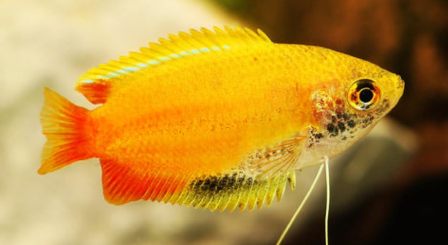
Common Angelfish Types / Colors
-
- Black & Black Long Fin: Fully black with standard or flowing long fins.
- Black and White (Marbled/Smoky): Striking patterns of black and white.
- White: A pristine, solid white coloration.
- Pearl Scale: Features a distinct, iridescent scale structure that gives the fish a shiny, pearl-like appearance.
- Koi: Displays a mix of orange, black, and silver coloring.
- Panda: White or light-colored with distinct black lines or spots.
- Blushing: Characterized by a red-to-pink coloration near the gills.
- Wild Caught: Exhibits the original white/silver body with distinct dark stripes running top to bottom.
- Blue: Has a very light blue sheen.
Image below is actually a link to a video (which opens in a new tab) entitled Freshwater Angelfish | Complete Care Guide & Species Profile by the Chiclid Bros

A portion of the video transcript:
“Different types of angelfish exist, but because they are South American Cichlids, their ideal tank parameters will be slightly lower on the pH scale, probably around 6 to 7-ish. Soft water is usually better, and their temperature range can be anywhere from about 77 to 86 degrees Fahrenheit. Sometimes, bumping up that temperature may induce breeding or just make them a little more aggressive, which we’ll discuss shortly.
Most angelfish in the hobby today are tank bred or locally sourced, so you won’t have to worry too much about matching those ideal wild parameters. I would usually just recommend keeping things as consistent as possible and, as always, focusing as much on your ammonia, nitrite, and nitrate levels, which are going to be much more important to keeping your angelfish healthy long-term. Although angelfish are relatively hardy, consistency and good water chemistry are key.”

To successfully maintain a healthy angelfish aquarium, you will need:
Behavior, Temperament and Tank Mates
Generally, angelfish are not aggressive toward their tank mates, provided the other fish are too large to fit into an angelfish’s mouth.
However, this changes dramatically when they form a mated pair. During breeding, angelfish become highly territorial and will aggressively guard the area around their eggs by chasing any fish they see.
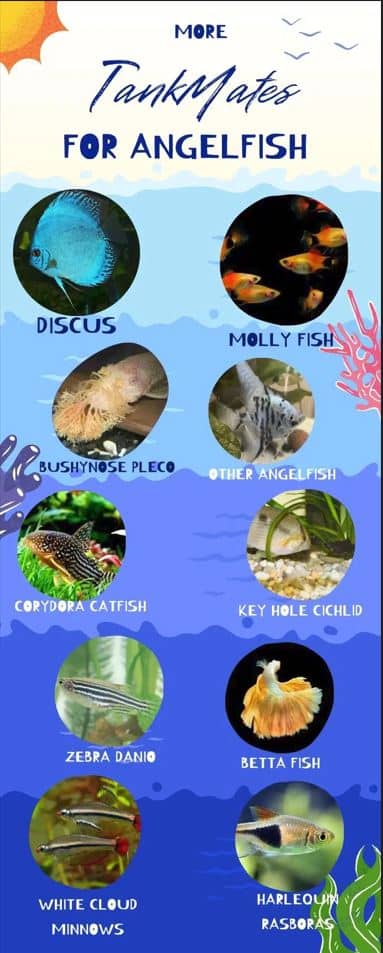
10 Suggested Tank Mates for Angelfish
1. Discus (Symphysodon discus): Compatible, but note that discus require warmer water, which may push the upper limits of the angelfish’s comfort zone.
2. Bristlenose (Bushynose) Pleco Plecostomus: Generally peaceful, bottom-dwelling algae eaters. Monitor to ensure they don’t nibble on your angelfish’s sides. To view tap here or the image:

3. Pictus Catfish (Pimelodus pictus): Non-aggressive, grows up to 4 to 5 inches.
4. Other Angelfish (Pterophyllum scalare): You can keep multiples together, provided the tank is large enough to prevent overcrowding.
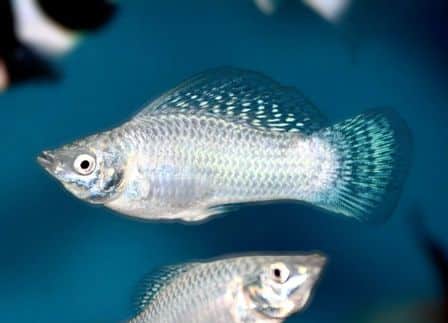
5. Molly Fish (Poecilia): Typically grow up to 3 or 4 inches and are very gentle.
6. Zebra Danios (Danio rerio): Danio’s are a schooling fish; keep a dozen or more for the best results and to distribute their energy.
7. German Blue Rams (Mikrogeophagus ramirezi): Peaceful South American cichlids that grow to about 2.5 inches.
8. Keyhole Cichlids (Cleithracara maronii): Reach up to 4 inches. Less common in stores but available online.
9. Golden Eye Cichlid (Nannacara anomala): Grows to around 2 inches. Can also be sourced online.
10. Kribensis (Pelvicachromis pulcher): A peaceful West African cichlid that can reach up to 5 inches, though often smaller in home aquariums.
Compatibility with other fish
“In pet stores, the freshwater angelfish is typically placed in the semiaggressive category. Some tetras and barbs are compatible with angelfish, but ones small enough to fit in the mouth of the angelfish may be eaten. Generous portions of food should be available so the angelfish do not get hungry and turn on their tank mates.
P. scalare and P. altum are described to be peaceful but territorial. While freshwater angelfish are often recommended for community aquaria, it has been reported that fin-nippers, such as tiger barbs, often target their long fins, and that freshwater angelfish become aggressive towards their companions as they grow. It is thus recommended that freshwater angelfish be kept instead in single-species aquaria.”
Angelfish Tank Décor
Natural Habitat Setup
In the wild, angelfish inhabit slow-moving blackwater streams. The water is low in pH and rich in tannins from decaying vegetation. The environment consists mainly of:
* Tree Branches/Driftwood: Large, submerged branches provide cover and surfaces for spawning.
* Leaf Litter: Decomposing leaves cover the stream bed and release tannins.
* Biofilm: A layer of bacteria and micro-organisms that coats surfaces, which angelfish may nibble on.
* To recreate this environment: Place dried leaves on the tank bottom (allow them to decompose naturally), add driftwood (for both tannin release and structure), and use reverse osmosis water to achieve soft, low-pH conditions.
Unusual and beautifully complex driftwood for freshwater aquariums.. Opens in a new tab.

Hobbyist Setup
A standard hobbyist tank provides an attractive and comfortable environment using:
* Natural-colored gravel or sand

* Stones and driftwood

* Live plants (Live plants are especially beneficial for water quality).
Rare aquarium plants on eBay. A few imported from Italy are extremely rare. Opens in a new tab.
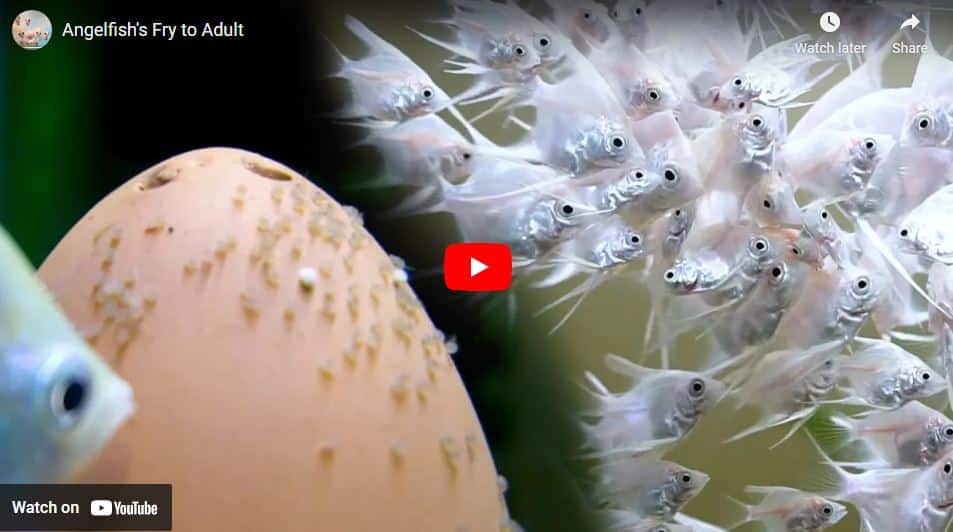
Breeding Angelfish Video
5 Remarkable Fish for the Beginning Aquarist

How to Successfully Breed Angelfish (Really)
While angelfish will often spawn in a community tank, getting the parents to successfully raise their fry can be challenging, as the breeding pair frequently eat their own eggs. Minimizing stress is the most critical factor for successful breeding and parenting.
Here are the top recommendations for a breeding pair:
1. Isolate the Pair: Place the breeding pair in their own tank to reduce visual stress from other fish.
2. Important – Control pH: Maintain a stable pH between 6.0 or somewhat below, which of course is very soft water. Higher pH levels increase the chances of the parents eating their eggs or the fry not surviving. I think the only way to do this is to use 100% reverse osmosis water.
3. Optimize Nutrition: Feed the pair high-quality food, preferably live or frozen-live. Poor nutrition is a significant stressor.
4. Important – Reduce Visual Stress: Block out the sides of the aquarium (by painting or covering them) to prevent the fish from seeing movement outside the tank.
5. Important – Dim the Lighting: Use dim lighting around the tank. Mimicking the natural blackwater, low-light environment helps them feel more secure.
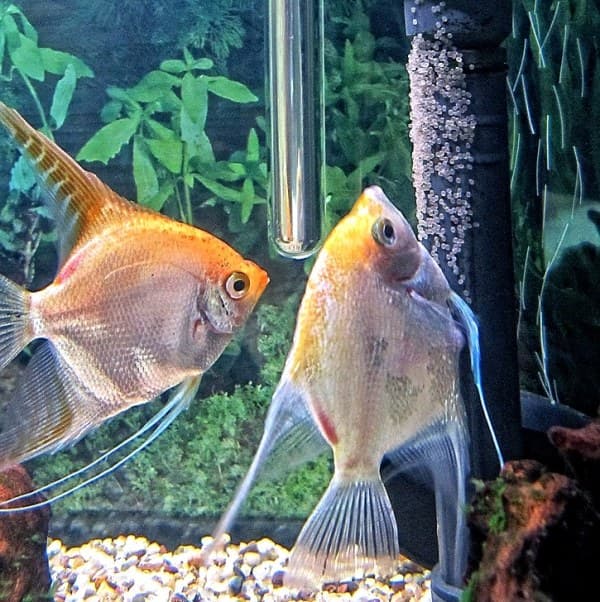
From Reddit R/angelfish (About mating)
Question: Tonight I noticed them (his Angelfish) both being very aggressive and hanging out at one side of the tank. They keep pecking at one specific leaf over and over again like they’re working on it as a team. Anytime another fish comes near they go after them. They have never done this and always lived happily with others. Why all of the sudden might they be doing this?
Answer: They’re paired up, that’s the best outcome when you roll the dice on two unsexed angels! Congrats 🙂
One is likely male and the other female, but tbh I’ve seen some same sex pairs form too.
What they’re doing atm is breeding behaviour, they’ve matured in the last 5 months and are now cleaning a surface (the leaf) in order to lay & fertilise eggs.
Adult angels (especially breeding ones!) get territorial and may be more aggressive to tankmates, which is what it sounds like ur dealing with.
(The) 20 Best Fish for Beginners
From About Angelfish – Breeding Angelfish: Information for the Beginner Angelfish Breeder
The common freshwater angelfish, Pterophyllum scarlare, are so easy to breed that you may find yourself as an accidental angelfish breeder when you suddenly spot a pile of eggs in your tank. If your angelfish have started a family without help from you, this information and tips will help you help the parents continue to care for their eggs and fry. Although once you’ve ventured into angelfish breeding, you may find yourself hooked.
Freshwater Angelfish (Pterophyllum scalare)
Ecological Risk Screening Summary
U.S. Fish & Wildlife Service, February 2011
(As an invasive species in the U.S.)
Means of Introductions in the United States
From Nico and Neilson (2018):
“High volumes of ornamental fish are imported into western industrialized countries, especially from South‐east Asia, Africa and South America (Keller and Lodge, 2007). These non‐native
species are reared in local farms or imported from abroad for ornamental or aesthetic reasons, such as private or public aquaria or gardens, for example, […], Pterophyllum sp. (scalar)…
How To Care For Tiger Barbs

 Video Link