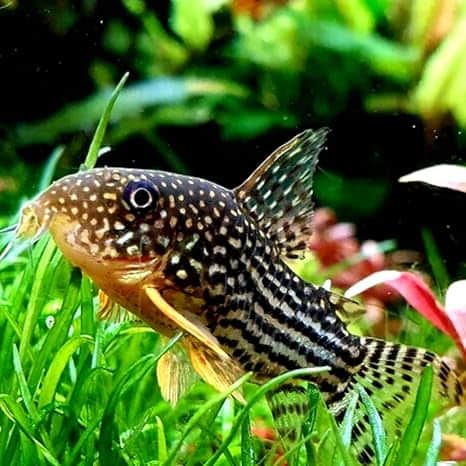
6 Steps To Easily Clean Your Aquarium Without Removing The Fish
In-depth answer to the question, “Is it OK to clean your fish aquarium without removing the fish?”:
Answer: “Yes, it’s ok to clean your aquarium with the fish still in it.”
Here’s why I am saying yes.
🐟 Cleaning a Fish Tank with Fish Still Inside: What Really Happens
A lot of what you’ll read online about cleaning a fish tank while the fish are still in it is speculation. This article, however, is based on decades of hands-on experience.
Aside from a five-year break, I’ve been keeping fish since 1988—over 30 years. After thousands of aquarium cleanings, I’ve developed a solid understanding of how different fish typically react during maintenance.
Notice I said “react,” not “feel.” As far as I know, fish don’t experience emotions the way humans do. Instead, they have built-in responses to stimuli—instinctive behaviors shaped by their natural environments.
🔁 Stimulus = Reaction: A Simple Example
What happens when you walk by your aquarium? Some fish rush to the front and top of the tank, swimming briskly. They’re not thinking, “If I beg for food, I might get fed.” More likely, this behavior mimics what they’d do in the wild during an insect swarm:
-
Swim actively = catch more insects
-
Stay still = go hungry
This same principle applies when you clean the tank.
🧽 How Fish React During Cleaning
Let’s say you insert a cleaning hose into the aquarium. What kind of reaction does that trigger? It depends on the species and their natural instincts.
For example, neon tetras, which are often prey in the wild, may interpret the hose as a predator. Their instinctive response?
-
Flee and hide until the “predator” (the hose) disappears. Once cleaning is done, they return to their normal behavior.

Image above: Neon tetras – Get some for your tank by tapping here.
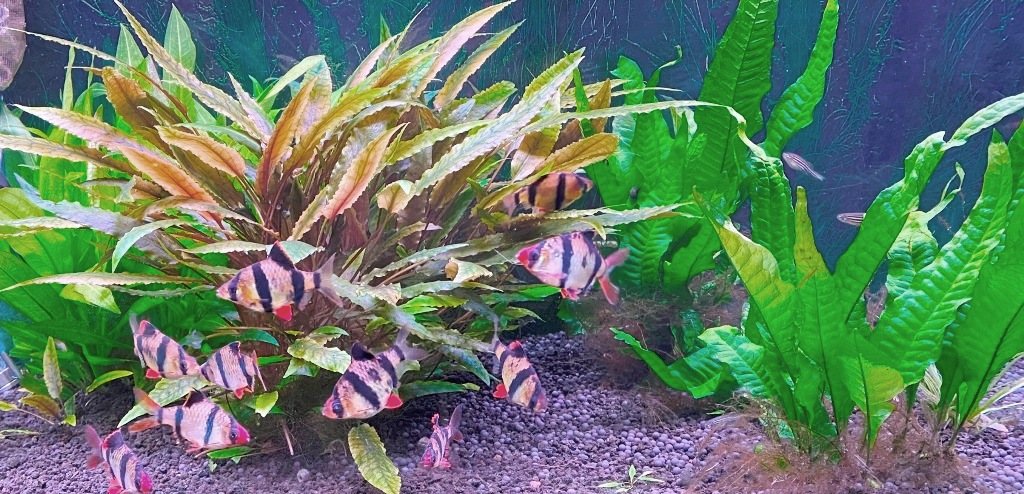
Image above: My 75 gallon aquarium. Large plants on the right are Java Ferns. Get some for you aquarium by tapping here.
A simple list of 6 steps to clean your aquarium
* Remove 10 to 50 percent of the aquarium water.
* Clean the filtration system.
* Trim any overgrown plants.
* Clean the glass on the inside of the aquarium.
* Refill the aquarium with pre-conditioned water.
* Clean the outside glass of the aquarium and the area around the aquarium.
How should you clean your aquarium with the fish still in it?
When and Why Should You Clean an Aquarium?
In a planted aquarium, cleaning may only be necessary every few months—and often only in response to a specific issue. Some common reasons include:
– **An unnoticed animal death**, which can affect water quality.
– **A dying plant**, especially if it produces excessive debris.
– **An algae bloom**, which is rare but may require both a water change and tank cleaning to resolve.
—
How Much Water Should You Remove?
This part is pretty straightforward. I use a siphon made from hard plastic aquarium tubing connected to flexible tubing. It’s small enough to remove debris from the substrate without disturbing the tank’s aesthetics. Others use tools like a measuring cup or even a turkey baster to scoop water.
The amount of water you change depends on the reason for cleaning. The bigger the issue—or the dirtier the tank—the more water you’ll want to replace. For example, I have two nano tanks (2 gallons and 2.8 gallons), and even a 1-gallon water change is a major shift in those setups. 🙂
⚠️ **Important:** Since your fish are still in the tank during cleaning, be extra cautious not to siphon, scoop, or accidentally harm them. In small tanks, it’s surprisingly easy to do.
—
### 🧼 Cleaning the Filtration System
If your tank has a filtration system (some low-tech or small tanks don’t), it will need occasional cleaning. The frequency depends on your tank’s **animal load**—that is, how many animals you have relative to the tank’s size.
In a healthy aquarium with a low animal load (which is ideal!), the filter only needs cleaning from time to time. Personally, I clean mine about four times a year.
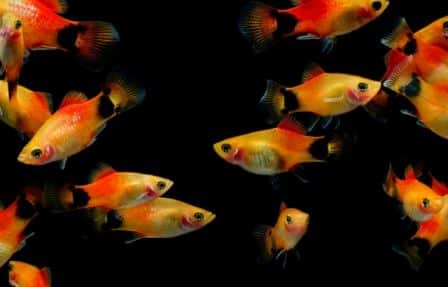
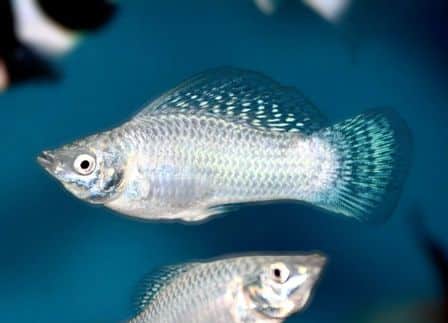
Image above Platy Fish. You can buy Platy Fish by tapping here.
Do Your Own SEO
You Can Get My DIY SEO System For Only $17.
Why pay an SEO person hundreds per month when you can do it yourself?
Dear Website Owner,
As you read this bear in mind that I'm not some internet website Guru. I'm just an average guy who has figured out a little about website SEO.
You originally started your blog to make money. Now the website is just sitting there, kind of taking up space online and taking money out of your pocket every month. Been there, done that. For example, my aquarium blog has been around since 2019. I work on it for a while, then set it aside (again!).
About a year ago I started teaching myself SEO by watching hundreds of hours of YouTube videos. I then developed my own DIY SEO system—a simple system that almost anyone could use. I tried it and it worked.
Before you dismiss this, here are a few of my results (I use Bing search for this snapshot because I believe Google currently relies too heavily on A.I. and sponsored ads):
#4 for Chinese Algae Eater Care (plantedaquariumexpert.com/chinese-algae-eater)
#1 for Rosette Sword Plant (plantedaquariumexpert.com/rosette-sword)
#1 for What to Feed Your Chinese Algae Eater (plantedaquariumexpert.com/feed-chinese-algae-eaters)
Get more information by tapping this box.
New Hobbyists Beware! Filtration System
Your aquarium’s filtration system is a major source of nitrifying bacteria, which are essential to maintaining a stable nitrogen cycle. Over-cleaning the filter can remove too much of this beneficial bacteria, potentially causing dangerous ammonia or nitrite spikes.
You’re likely already aware of how harmful ammonia can be to fish and shrimp. The challenge is cleaning the filter without disrupting the bacterial balance. It’s surprisingly easy to upset this delicate ecosystem—so tread lightly when cleaning your filtration system.
🛡️ Four Key Tips to Preserve Beneficial Bacteria
- Rinse filter padding in tank water—not tap water. If you plan to reuse the filter padding, rinse it gently in the water you’ve just removed from the tank. Avoid over-cleaning, and never use tap water, which can kill beneficial bacteria.
- Use permanent hard filter media. Ceramic or plastic balls, pellets, or noodles are ideal. Their textured surfaces promote bacterial growth, helping your tank stay safe from ammonia and nitrite spikes. Do not clean this media—I never do.
- Avoid cleaning the interior plastic parts of the filter. Only clean them if absolutely necessary, and even then, do so minimally. That slimy coating you feel? It’s beneficial bacteria. Try to leave it intact during maintenance.
- It’s okay to clean the impeller and its housing. This helps maintain proper water flow and prevents clogging. Just be gentle and avoid disturbing other parts of the filter.
🌿 Trim Plants and Remove Hair Algae
A healthy aquarium encourages plant growth, which is a sign your setup is working well. If you’re aiming for a landscaped look, regular trimming is essential. The amount of trimming depends on your tank’s size and the types of plants you’re growing.
If you notice hair algae—which is common even in healthy planted tanks—remove it. I usually use my siphon to twirl it up like spaghetti. I recently read about using pipe cleaners for this task, which sounds promising (though I haven’t tried it yet). You can also remove it by hand when possible.


My pick for Best on Amazon "Small Plecostomus Fish":
Golden, Blue Eye Long Fin Pleco
Choice was based on:
⇒ Unusual and attractive colors
⇒ This pleco grows to no more than 4.5 inches.

Tap this box to view or buy
🧼 How to Clean the Inside Glass of Your Aquarium
Let’s assume you have a glass aquarium—not acrylic—since acrylic scratches more easily.
Personally, I clean the inside glass only when algae builds up or when hard water deposits form around the top edge.
Here are the methods I’ve used to clean the glass:
🧲 Magnetic Scrubber (My Favorite)
A magnetic scrubber comes in two parts:
-
Inside piece: has a scrubbing pad and goes inside the tank.
-
Outside piece: covered in felt and goes on the outside.
Both parts contain strong magnets that hold them together through the glass. As you move the outside piece, the inside scrubber follows, cleaning the glass as it moves. It’s effective and keeps your hands dry!
🪒 Razor Blade Scraper
This tool works well for stubborn buildup, but it might be overkill for small tanks. Use with caution to avoid scratching the glass.
🧽 Plastic Scrubbing Pads
If you don’t mind getting your hands wet, these work great. I always use pads purchased specifically for aquarium use. Avoid pads with attached sponges, as they often contain soap or chemicals. Rinse the pads thoroughly in tap water before first use.
Also, wash and rinse your hands thoroughly before putting them in the tank to avoid introducing contaminants.
💧 Refilling the Aquarium & Cleaning the Outside
Refilling a small tank is simple:
* Fill a container with tap water at the same temperature as your tank.
* Add your preferred water conditioner to neutralize chlorine, chloramine, and heavy metals.
* Pour the conditioned water gently into the tank to avoid disturbing the substrate.
After refilling, wipe down the outside glass to remove water spots. You’ve put effort into making your aquarium look beautiful—don’t let smudges ruin the view! This also helps if you want to take photos of your tank.
Cleaning your aquarium is easier than it sounds—and the results are totally worth it. Your tank will look stunning and your aquatic friends will thank you. 🐟✨
More information:
Video: How to Properly Clean Your Fish Tank (Detailed Version)
Video: How to Clean Your Fish Tank – NEED to Know
Video: Aquarium Water Change – Sand Vac and Full Tank Cleaning (80% Water Change)
Other pages on this site:
⇒ How to keep freshwater shrimp
⇒ 10 fast growing plants to help control algae in the planted aquarium
⇒ Taking photos of your aquarium using your smartphone
⇒ Aquarium Hobbyist Books & Gifts
⇒ My Top 3 Steps To Have Healthy Fish and A Healthy Aquarium


My pick for Best On Amazon for "Corydora Catfish":
Long Fin Panda Cory
Choice was based on:
* I've never seen a long fin corydora.
* Beautiful & somewhat unusual markings.
* Fish and seller have excellent reviews


Tap this box to view current price.
My Choice For Best On Amazon, "Platies"
SunBurst Platy

Tap this box to view current price.
- From the seller:
✅ Sunburst Platy, scientifically known as Xiphophorus maculatus, is a vibrant and attractive species of livebearer fish - ✅ They are named "Sunburst" due to their stunning coloration, which includes shades of yellow, orange, and red, reminiscent of a radiant burst of sunlight
- ✅ Sunburst Platys are known for their peaceful temperament, making them ideal for community aquariums with other peaceful fish species
- ✅ These fish are relatively small in size, reaching an average length of 2.5-3 inches (6-8 cm), making them suitable for smaller aquariums
- ✅ Sunburst Platys have adaptable water parameter requirements, but they generally prefer temperatures between 72-82°F (22-28°C) and a pH level of 7.0-8.0
How to clean your aquarium without removing your fish...