
Oscar Fish Care – The Ultimate Beginner Guide For This Magnificent and Intelligent Fish
Species Summary
Appearance
How big do Oscars get?
The first thing to understand is how large they get. The can grow to be 18 inches long and weigh in at 3.5 pounds (1.6 kilograms) in a home aquarium. In other words, This a big fish.
Young Oscars
Juvenile Oscars are usually white and dark brown, and with white spots on the head.
Color Changes at Will
Not often mentioned, but mature Oscars are able to change scale color when fighting or breeding. This is a common trait of South American Cichlids. They can “color up” when they want or need to.
The “Tail Eye”
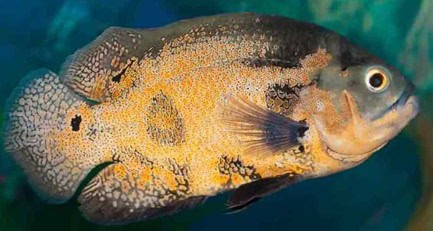
Wild Oscars also have a circle of light colored scales near the tail. Theory is that the circle of scales looks like an eye. This eye confuses predators, usually piranha which live in the same environment. It’s possible that the predators are tricked into thinking they are taking a bite out of the body of the Oscar. Instead they might get a nibble of a tailfin.
A. ocellatus examples have been reported to grow to about 70 cm (28 in) in length and 9 kilograms (20 lb) in weight. The wild-caught forms of the species are typically darkly coloured with yellow-ringed spots or ocelli on the caudal peduncle and on the dorsal fin. These ocelli have been suggested to function to limit fin-nipping by piranha (Serrasalmus spp.), which co-occur with A. ocellatus in its natural environment.
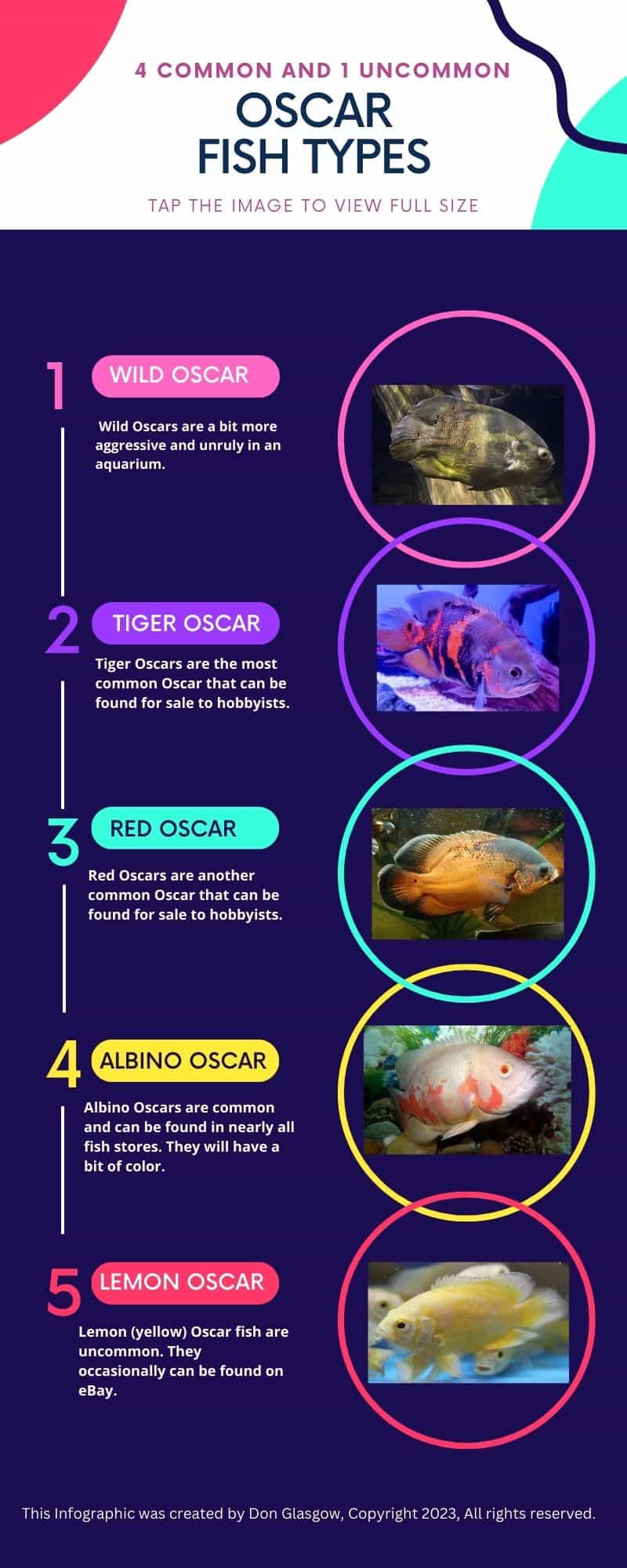
Tiger Oscar Size
12 inches is the average length considered for the Oscar varieties. However, in the wild, they can grow even longer than that. 18 inches of length could be the maximum limit for this fish in the wild. – Tiger Oscar Care Sheet (Size, Behavior, Food, Tank Mates)
Harold Miller – FishCaring.com
Behavior & Temperament
Behavior and Interaction with other fish and potential tank mates.
Oscars are a rather aggressive and territorial species. Be aware of this in choosing the tank size and tank mates. My one try at Oscars I was awoken at 3:00 AM by my new Oscar fighting with the other large fish in my living room aquarium.
Taking this into account and their large size, make sure you have a tank large enough for the Oscar and their tank mates.
Interactions with the owner
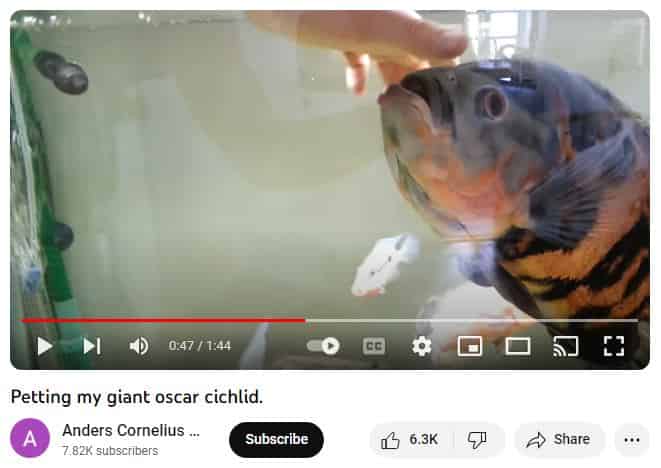
Oscars are one of the most intelligent fish in the hobby. As I mentioned earlier your Oscar may end up feeling like a pet, rather than a fish. This is because they will interact with their owners even to the point of watching the owners as they move around the room where the aquarium is located.
Here are a few posts from Reddit r/aquariums about Oscar behavior:
“You have an Oscar. There’s your problem. Just make sure he can’t get the cat.”
“I love my Oscar. His personality is closer to that of a dog. During feeding time he would come to the front of the tank and almost way like a dog for food. He would eat out of my hand and was a joy to keep.”
Video: Petting my Oscar Fish https://www.youtube.com/watch?v=kmmGAlzfvv4
Are Oscars Difficult or Easy To Care For?
They are about as easy to care for as any other South American Cichlid. This means they are fairly hardy but if neglected they will become sick and if uncared for they will die.
Because of their size they are a little more challenging to care for than smaller fish.
Tiger Oscar Size
12 inches is the average length considered for the Oscar varieties. However, in the wild, they can grow even longer than that. 18 inches of length could be the maximum limit for this fish in the wild. – Tiger Oscar Care Sheet (Size, Behavior, Food, Tank Mates)
Harold Miller – FishCaring.com
Yes, I really did this.
My Experience With Making Money Doing an Online Interview.
I made $60 for a 1 hour interview.
A while back I participated in an online video interview. It took less than an hour, and I received a $60 Amazon gift card. The company I signed up with (Respondent) has tons of different surveys and interviews to choose from. You can only be paid with gift cards, but honestly, I got some good stuff from Amazon for an hour of my time.
It’s easy, and if you choose well, it pays well. You make money, and if you complete $75 in surveys, I’ll also earn a little ($20). Win win for both of us.
Here are some of the surveys available as I write this:
-
Snack food interview — 23 minutes — $30
-
Work in e-commerce? — 20 minutes — $100
-
Content creators — 60 minutes — $100

How Long Do Oscars Live?
The lifespan of an Oscar Fish should be taken into account before taking the Oscar home from the local fish store.
You need to be aware that Oscars live for 8 to 15 years in an aquarium.
Let’s say that your Oscar lives for 15 years. That’s an important number. Do you have the stability to house a fish for 15 years?
As I will discuss further down in this article, there are three important factors that dictate how long an Oscar fish will live:
* Tank size: Your Oscar will need a large aquarium within no more than a year.
* Water quality: Clean water and a clean tank will keep your fish from becoming stressed. Stress leads to illness. The life of an Oscar fish can and will be shortened due to a continual dirty tank.
* Diet: A good diet with lots of different types of foods. Important: feeding your Oscar “feeder fish” from the local pet store can often lead to your fish being infected by disease.
Bottom line is that if you take good care of your Oscar fish you will have them around for a long time.
Best Tank Mates for Your Oscar
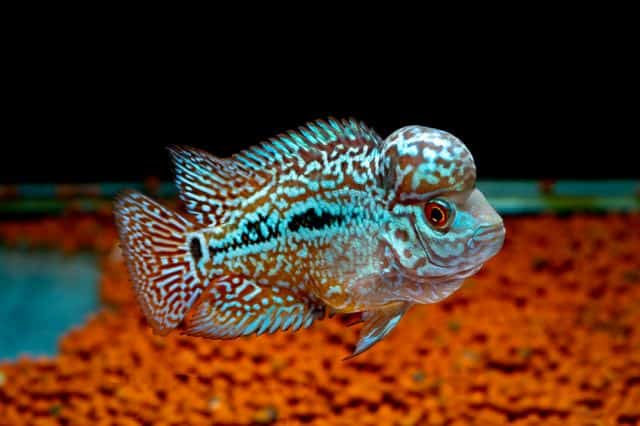
Above: The colorful Firehorn fish grows to 12 inches to sometimes as much as 16 inches.
How many tank mates you have in your Oscar tank depends on the size of the aquarium and how diligent you are in keeping the tank clean.
I wouldn’t have only one extra fish in the tank. The Oscar might bully it and end up killing it. Having a few fish should be distracting enough so that doesn’t happen.
As far as types of fish to have in an Oscar fish tank, of course “big” is the first word to us. If a tank mate is too small, they will be eaten. So you need to add at least 3 more fish, again being careful about tank size. The more large fish you have, the larger the aquarium should be.
Another thing to be aware of is how large your Oscar is. If he / she is young and smaller you can add fish that will grow out to appropriate size to keep with an Oscar. If your Oscar is a “rescue” Oscar and is adult size, the other fish will need to be adult size as well.
Fish that could be considered for Oscar Fish Tank Mates:
* Jack Dempsy fish – grows to 10 inches long.
* Frontosa fish – grows to 15 inches long.
* Maybe other Oscars – there are two issues with this. 1. They might fight. 2. They might mate. If you get a mating pair on accident you will probably have to take the other fish out of the Oscar tank because as the Oscars guard their mating territory they could end up killing the other fish.
* Royal Pleco – grows to 16 inches. Fairly attractive fish. I kept one for a long time before giving it to someone I worked with.
* Jewel cichlid – Grows to 6 inches
* Green Terror cichlid – Grows to 12 inches
* Blood parrot cichlid – grows to 12 inches
Clown Loach – grows to 12 inches
_________________________________
Side note: Rescue Fish
When I go into my local fish store, I always see mature Oscars and other large fish that have been given to the store because the original owners either didn’t want the Oscar any more or they couldn’t keep them for whatever reason.
A baby Oscar is going to get big, so you might as well start with a big Oscar by taking home one of these “orphan” Oscars. Your new adult Oscar will love you for it.
It is possible that a few of the other big rescue fish will go great with your new Oscar.
“Fish adoption is a wonderful way to provide a Fish a second chance and caring environment. Most pets arrive at shelters because the owner had to move, could no longer afford the pet, had a death in the family, or simply gave up the responsibly of being a care taker for a Fish.” – Fishes for Adoption – Search & Adopt a Fish

My pick for Best On Amazon for "Oscar Tankmates":
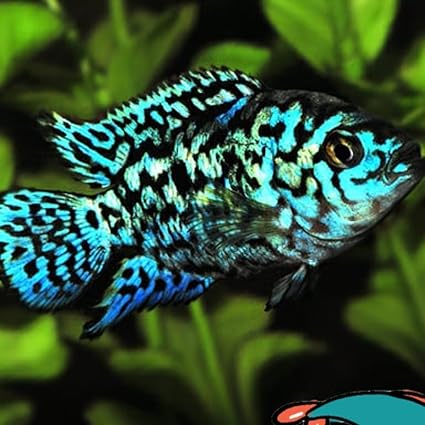
Electric Blue Jack Dempsey Cichlid
Choice was based on:
⇒ Outstanding colors on the adults.
⇒ Jack Dempseys may grow to be up to 15 inches long. Perfect for a tank filled with other large fish.
⇒ Seller and fish has many, many positive reviews
⇒ Tap this box to view current price
Tap this box to view current price.
Oscar Tank Maintenence
As mentioned at the first part of this article is that Oscars are not easy fish to take care of. That’s mainly due to their size. A 16 inch aquarium fish is huge, which leads to buying a huge tank, dealing with huge poops, feeding huge amounts of food, and doing huge numbers of aquarium cleanings.
Of course there is also the huge costs to get started. An inexpensive 90 gallon aquarium and stand, bare, could cost $1,000 or more. When buying the rest of the set up for the Oscar Fish tank a cost another $1,000 is not out of the question.
All done to keep your Oscar healthy so it can live a normal life span.
Let’s dig a little deeper…
Besides tank maintenance, there are a few other factors which govern the health of your Oscar fish. These are all factors which you control.
As mentioned, water quality is an important factor in keeping Oscar fish. The closer you can get to the conditions in the Amazon River Basin waters, the less stress your fish will have. This means your Oscar will be better able to fight potential disease.
Aquarists have a small amount of control over the water hardness. I use a reverse osmosis water filter to remove minerals in the water that I use when cleaning my fish tanks.
I know that feeding fish (fish foods) adds minerals back into the aquarium water. This is part of the reason to do water changes on a regular basis. By regular I mean massive water changes of 50% or more, done weekly or more often.
I use reverse osmosis water as the replacement water so that I can start with water that is very low in minerals.
Essential Water Conditions
You decide to buy an Oscar because it’s small and cute. You take it home and put it in a 55 gallon aquarium with your other community fish. Six months later, you notice that it is getting easier to keep your aquarium clean. That’s because every few days you have one less fish in your tank with your now eight inch Oscar.
Six months after that, you have no community fish and a 12 inch Oscar laying on its side dying because the tank is too small for such a large fish.
While you can’t force a dying Oscar to get better, you can take steps to ensure that this doesn’t happen.
The most important idea I can convey to you is how large of an aquarium you will need for your 14, 16 or 18 inch Oscar.
I certainly wouldn’t go smaller than a 90 gallon tank. 90 gallons is barely big enough for such a large fish. If I had the money, I would probably aim for a 150 to 200 gallon tank.
Why would I suggest this size tank? Two reasons actually: 1. You don’t want your Oscar stressed out because its tank is too small. Stress kills fish fairly quickly. 2. A large tank won’t have large fluctuations in water parameters.
It’s fairly easy to figure out what water conditions or parameters an Oscar Fish needs. They are native to the South American Amazon River Basin.
Water Temperatures
First off, the water temperatures need to be fairly consistent. Suggested temperatures are 75 degrees F (24 degrees C) and up to 82 degrees F (28 degrees C) on the upper end. I try to keep my aquarium water temperatures around 78 degrees F. I try not to do too much adjusting of the heater in the tank. For several weeks now, the temperature in my 30 gallon planted, tiger barb aquarium has been 77 degrees, which is close enough to 78 degrees that I’m not going to mess with that parameter.
Water softness of the Amazon Basin
Amazon fish live in soft water. Water hardness is measured mostly by the amount of dissolved solids in the water. Those solids are usually calcium and magnesium. The numbers are parts per million.
Amazon River Basin fish live in water that is maybe 10 to 30 PPM dissolved solids. This is very soft water. These numbers let you know how hard the water should be for your Oscar. All of this said your Oscar fish can get used to hard tap water.
Water pH
PH is a measurement of acidity of substances (such as aquarium water) on a scale of 0 to 14. 7 pH is neutral. Hydrochloric acid has a pH of .5. Baking soda has a pH of 9.
The dissolved solids in water acts as a buffer against acidity. What this means is that the higher the dissolved solids in water the higher the pH. The less dissolved solids usually means a lower the pH.
Amazon River water has a low pH due to how soft the water is. Low pH is water that is lower than 7 pH.
So, fish that originated in the Amazon area need soft water with a low pH. Just as an example, Neon and Cardinal Tetras can be found in water that has a pH of 6 or lower. That is very acidic.
So bottom line for suggested water parameters for an Oscar fish is soft water (10 to 30 PPM) and a pH lower than 7. This said they can become acclimated to tap water that has a hardness of 100 PPM, give or take.
Water Filtration
Most hobbyists:
Filtration is an important part of keeping an Oscar fish tank clean. I will tell you what I suggest and then I will tell you what I would do.
Fish keepers will suggest one large filter to one large fish tank. With a 100 gallon tank, it would be wise to purchase a canister filter that would run the entire water volume of the tank through the filter several times per hour.
What I do (would do) to filter an aquarium:
What I would do is to have at least two large canister filters running 24/7/365. For example, I have a 30 gallon aquarium that has two Fluval 207 canister filters set up. Filtration is measured in gallons per hour. Under the best conditions, each Fluval will pump 206 gallons of water through the filter media or a total together of 412 gallons per hour. This is a “water turnover” of 13.5 times the water volume per hour.
Besides this, I also have a 400 gallon per hour powerhead running near the bottom of the aquarium (no filter). This is to help keep debris from settling on the gravel.
I also have a UV sterilizer hooked up to each of the return tubes of the Fluvals. Having these keeps the parasites, bad bacteria, fungus, and algae in check.
My pick for Best On Amazon for "Planted Aquarium Light":
Hygger Advanced LED Aquarium Light
Choice was based on:
⇒ Number one is that I own three of these lights. They are tried and true.
⇒ Great reviews: 4.5 stars, 3247 total reviews
⇒ Programmable
⇒ Tap this box to view current price

Tap this box to view current price.
What To Feed Your Oscar
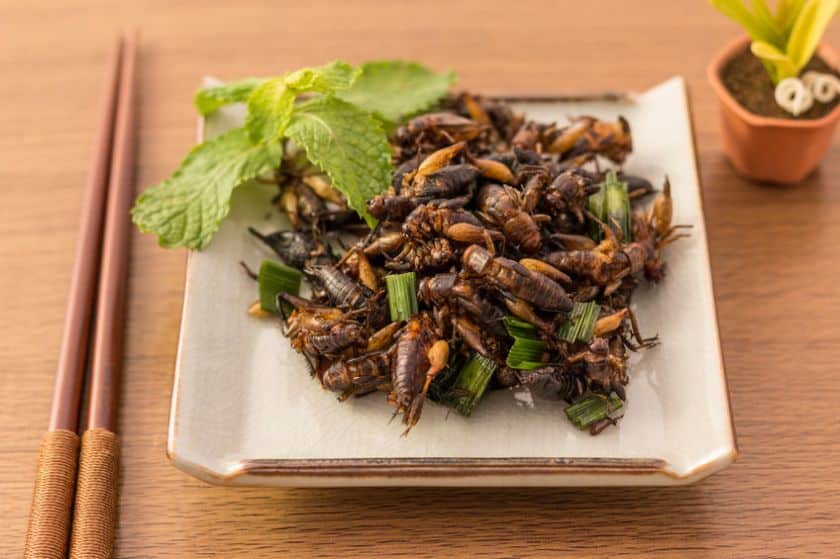
Image above: A plate of crickets
First, I would say that in regards to feeding your Oscar you will want to keep an eye on them after you feed them. It’s quite easy to over feed a fish. If you feed the Oscar and walk away, you won’t know if you’ve overfed or less likely, underfed, your fish.
You will want to feed your Oscar Fish about twice a day. That’s what I my fish and it works for me.
To keep your Oscar healthy you want to provide him or her with a varied diet of processed flake and pellet foods, canned or fresh cooked veggies, frozen foods like brine shrimp, blood worms and frozen feeder mice (when your Oscar is large enough), and live foods like crickets.
Top of the Food Chain: Feeding Oscars in the Home Aquarium – Tropical Fish Magazine
Aquascaping An Oscar Habitat
The best decorated Oscar fish tank set up I have seen is an aquarium with these items:
1. A very thin layer of large pebbles covering the bottom of the tank.
2. A bunch of large, roundish rocks piled together that were holding a large piece of driftwood firmly in place. I don’t know for sure, but the rocks may have been glued together. Not a bad idea if so.
This is a set up that, except for the pebbles, the Oscar Fish couldn’t rearrange and it was fairly attractive.
Plants
It is quite possible to have plants in your Oscar tank. But it is also possible that you might get an Oscar that hates plants. From what I’ve seen is that only having one or two plants is a bad idea. The Oscar may beat up the plants because…well, because he’s an Oscar.
I have seen several YouTube Videos that showed planted Oscar tanks. Adding a Mature Oscar to a well planted tank that already has a few other fish in it to distract the Oscar from the plants, makes having a planted Oscar aquarium quite possible. You just have to get the aquarium totally set up ahead of time and make sure that the tank is full of plants.
How to breed Oscar Fish
Like all South American cichlids, breeding Oscars is pretty straight forward. A healthy, well-fed male and female will breed without almost any help from the owner.
Determining which is a male Oscar and which is a Female Oscar
1. A male will have a slightly rounder head vs the female whose head slopes back with no bump or hump.
2. Full mature males will be larger than the females. Not by a lot, but noticeably bigger.
3. Male Oscars will have three darker spots at the base of the dorsal (back) fin. Females just have one large spot and not as dark. This is not always an indication. If the fish is highly inbred, these indicative colors may have been bred out of the fish.
4. Males will have a small protrusion near the anus. Females will have a small tube near the anus that lies flat against her belly.
Breeding Tank
When that’s ready, place the male and female pair in the breeding aquarium. Feed them a high protein diet, but of course, keep the tank clean. The bottom of the tank should have some gravel as breeding pairs like to dig. I have also seen flat rocks put in the breeding tank as a place to lay the eggs.
Important: Keep the breeding pair by themselves in their own breeding tank. If you leave fish in the tank with them, there is a chance they will kill those fish in their efforts to protect the eggs.
Courtship
The pair of fish will begin courtship by appearing to fight. This activity is open mouthed, pushing against each other.
Egg Laying
They will eventually lay the eggs and fertilize them. The female may lay up to 1,000 eggs. If the Oscars feel safe and the water parameters are near optimum, they will take good care of the eggs by fanning them and then the hatched wigglers.
Eggs —- Wigglers — Fry
When the fry are free-swimming, begin feeding them processed fry foods, cooked egg yolk, and newly hatched brine shrimp. Live daphnia and micro worms are small enough that when the fry are a bit bigger, they will eat that live food as well.
Fully swimming baby oscars
The parents will continue to care for the baby Oscars. Fully swimming fry can be separated from the parents. At that point you can grow out the fry until they are of a sellable size.
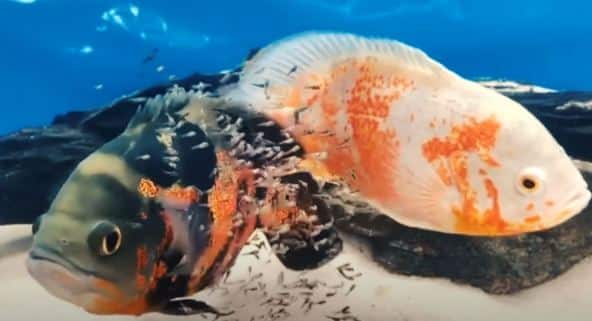
Below is a link to an awesome video that shows a mated oscar pair breeding and raising young.
Tap image to view. (opens in a new tab or window)
Diseases That Oscar Fish Can Get
Oscars are sturdy fish, and they rarely get sick. There are five diseases that can affect them with a certain regularity.
Disease is caused by the owner’s negligence.
Something I’ve learned over the decades of keeping fish is that fish become ill and die due to the owners incorrect choices, ignorance, or laziness.
More and larger water changes will prevent diseases. Its possible that water changes alone will cure your sick fish.
Bottomline: If you clean the tank frequently and add a UV sterlizer it is unlikely that your Oscar will get sick.
Hole in the head (HITH)
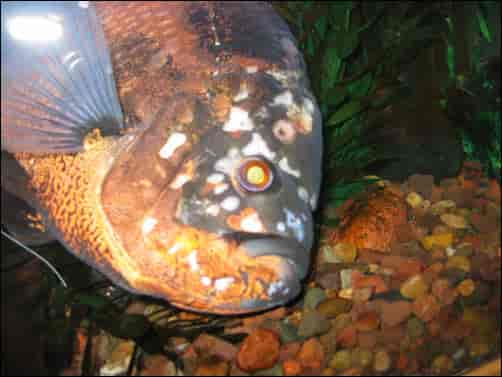
An Oscar that died from hole-in-the-head disease – image provided by wikimedia
As the name says, hole-in-the-head disease manifests itself through small holes and sores around the head of the Oscar fish.
Experts do not agree on the cause—some believe it’s parasitical, others affirm a poor diet and a deficit in vitamins C and D could be responsible. A third opinion believes it’s the result of a chemical and mineral imbalance in the aquarium water.
Regardless, the treatment options are simple. Metronidazole in the water should help with the sores, while an evaluation of the water’s chemical balance and the Oscar’s diet might improve symptoms as well.
Fin and tail rot
Fin and tail rot attacks the Oscar’s fins, causing progressive damage and, eventually, complete fin decay. This disease is a bacterial infection, and it’s widespread in aquariums with poor living conditions.
Over-the-counter antibiotics, such as tetracycline or oxytetracycline, should stop the infection. However, it’s imperative to clean the water and improve the tank’s living conditions to prevent future breakouts.
Pop-eye disease
Your Oscar’s eyes may bulge or swell, looking cloudy and out of focus. If untreated, the outcome would be the loss of the affected eye, so address the issue as soon as possible.
Pop-eye disease can have many causes. It could be caused by a bacterial infection as a result of trauma to the eye. It also could be caused by inadequate tank conditions. Regardless, the best option is to improve the water quality (larger and more frequent water changes) and treat the fish with antibiotics.
Ich
Ich is one of the most common diseases in aquarium fish. ich is identifiable by the appearance of white spots on the body and the reddening of the fins.
There are multiple products to treat ich, and the most effective options involve sea salt, malachite green, copper sulfate, and formaldehyde.
Bloat
Oscars are prone to bloat. If your fish has a bloated appearance, a lack of bowel movements, and produces hard feces, you might need to treat its constipation.
The most effective approach is to induce a temporary diet change—feed the Oscar peeled, soft peas, and you may see results within days.

Are Oscars suitable for your aquarium?
Buy a huge aquarium and give them a go. You can’t learn unless you try something new.
Additional Oscar information and references:
https://www.aquariumindustries.com.au/wp-content/uploads/2015/03/Oscar.pdf
Other pages on this site:
⇒ How to keep freshwater shrimp
⇒ 10 fast growing plants to help control algae in the planted aquarium
⇒ Taking photos of your aquarium using your smartphone
⇒ Aquarium Hobbyist Books & Gifts
⇒ My Top 3 Steps To Have Healthy Fish and A Healthy Aquarium