
HOW DO YOU GET RID OF ALGAE IN YOUR AQUARIUM?
5 Effective Removal Tips
Key Takeaways From This Article:
* Algae can be removed by hand.
* Large water changes can help control green water algae.
* Fish, snails, and shrimp can help with algae control.
* Hydrogen Peroxide if used carefully can help control algae.
* Adjusting the lighting time or intensity is another way to keep a mostly algae free tank.
* There is input from Reddit, Wikipedia, and www.aquasabi.com.
* FAQ’s on algae are included.
If you have an aquarium you have algae. I have a heavily planted aquarium. It always has some algae on the glass. I clean it off by hand weekly during my water changes. Below is a picture on my 75 gallon that I took today (Sept. 21/2025). If you look closely you can see the algae growing on the glass.

The following ideas will help keep the algae in your fish tank under control. Knowing how to control its progress is key to having a sparkling clean display of your fish tank. I’m going to go over a few very affective ways to control algae when it tries to take over your fish tank.
1. Hands-On Algae Removal: Scrub, Scrape, and Pull – Get rid of algae in your aquarium step 1
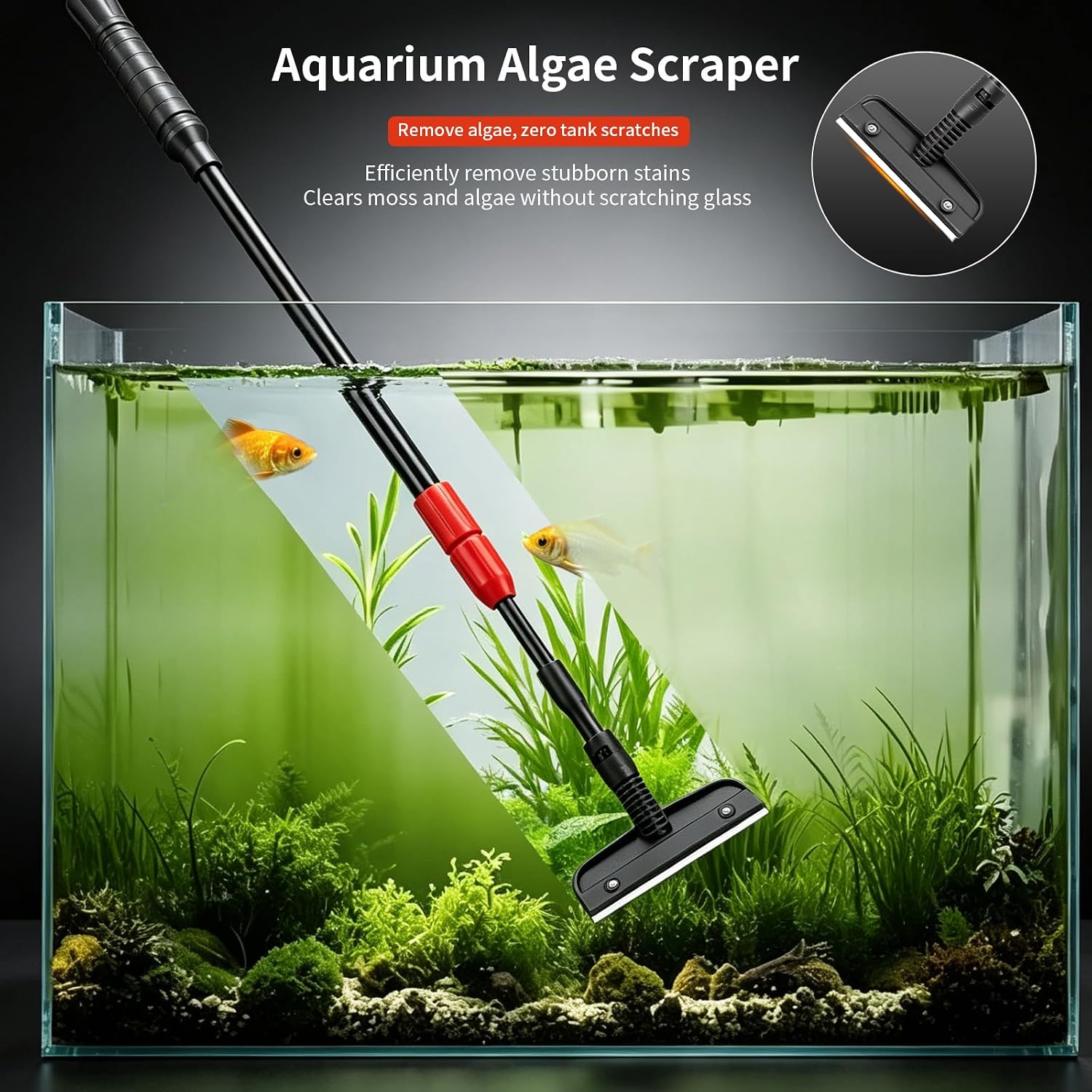
To quickly remove algae from your fish tank, scrubbing and scraping are the most direct methods. You can use a scrub pad or a magnetic algae scraper on glass surfaces.
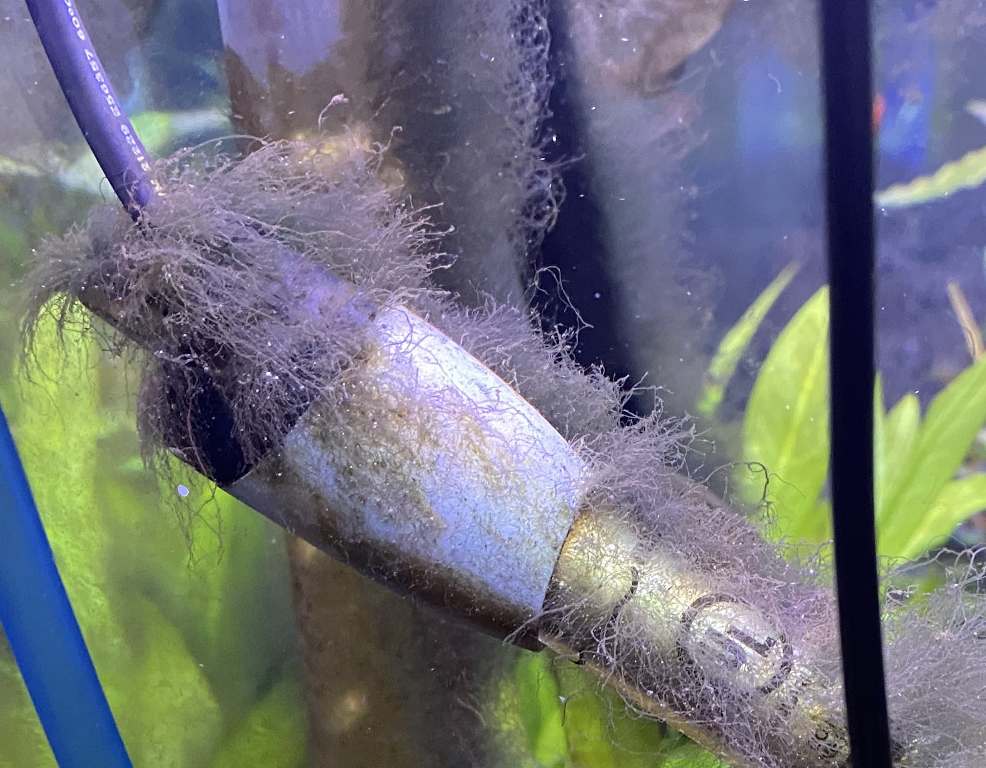
Hair algae often attaches to aquarium plants and decorations, forming long, thin strands that sway in the water current. For larger clumps, you can pull them off by hand. Another effective method is to use a thin plastic aquarium tube. Push the tubing into the algae clump and twist it as if you were winding spaghetti on a fork. A firm pull should then remove a large clump. Some aquarists also find success using pipe cleaners.
From Wikipedia:
There are many types of algae that are commonly found in a freshwater aquarium setting. Species may be unintentionally disseminated through spores and fragments that hitchhike on ornamental fish and plants purchased from aquarium suppliers. Algae is typically considered a nuisance and subject to removal through the use of algaecides and the release of algae eaters. However, total elimination of algae is considered unlikely in a hobby aquarium.
Author Bio: Don Glasgow - creator of this site
* I've been keeping fish for 24 years, including Discus, Angelfish, Betta Fish, Tiger Barbs, Bristlenose Plecos, Zebra Danios and many, many more.
* I've have been keeping planted aquariums for 23 of those 24 years. Plants I've kept include Java Fern, Sword Plants, Rosette Sword and more.

How Many Gallons Does Your Aquarium Hold?
Aquarium Gallon Calculator
Enter your aquarium dimensions in inches.2. The Ultimate Green Water Fix—Large Water Changes Explained
Making frequent, large water changes is one of the most reliable ways to remove algae from a fish tank. This method works by reducing nitrate levels, which are the primary fuel for algae growth. Reducing nitrates is conditioned on whether your tap water is free of nitrate. Most tap water is not. I use reverse osmosis water instead of tap water. Reverse osmosis water: no nitrates.
While many other methods only treat the visible algae (the symptom), water changes address the underlying cause: excess nutrients.
Fish tanks naturally contain nutrients that are available for algae through the nitrogen cycle. This process begins with fish food, fish waste, and decaying plants breaking down. Beneficial bacteria then convert this decay into ammonia, followed by other bacteria changing the ammonia into nitrite. Finally, more bacteria convert the nitrite into nitrate—a common fertilizer. By performing regular water changes, you effectively reduce nitrate levels and make long-term algae removal much easier.
 A portion of the video transcript. The video is quite short:
“Okay quick update on the 30- gallon aquarium. It’s mostly hair algae free. It’s kind of fighting to try to get back but anyway to get to this point. Sorry about the reflection. I am changing about five gallons of water per day in an effort to bring the nitrates down to zero if I can. Obviously that’s impossible.”

3. The Clean Up Crew…
Meet the Tankmates That Will Keep Your Aquarium Sparkling Clean and Clear
Another natural way to remove algae from a fish tank is by introducing helpful tankmates. Certain fish, shrimp, and snails graze on algae, reducing buildup between cleanings.
1. Freshwater Shrimp
Amano Shrimp (Caridina multidentata) are especially effective algae eaters. They not only consume algae but also help keep gravel clean.
2. Sucker-Mouth Fish
Bristlenose Plecos are great choices, as they graze on algae growing along glass and decorations. Mollies can also help with algae control, though keep in mind they reproduce quickly.
3. Freshwater Snails
Popular options include Malaysian Trumpet Snails, Ramshorn Snails, Nerite Snails, and Rabbit Snails. Personally, I prefer Ramshorn Snails for algae control, but they can be difficult to keep if you have Tiger Barbs—those fish see them as an easy snack.
⇒ Important note on Chinese Algae Eaters: Don’t buy Chinese Algae Eaters to clean up algae. The get huge and become aggressive as they grow.
Shop Amazon for animals that will clean up aquarium algae for you

Tap This Box To View All Selections
4. Use Hydrogen Peroxide on the algae
Hydrogen peroxide (H₂O₂) is a powerful tool if you’re trying to remove algae from a fish tank that won’t respond to scrubbing or water changes. When applied correctly, algae turn white or pink and die within 24 hours.
In the U.S., store-bought hydrogen peroxide is usually a 3% solution and doesn’t need dilution. Stronger solutions should be diluted to 3–8%.
How to use hydrogen peroxide to clear up algae in your fish tank:
* Turn off all water-moving equipment (filters, powerheads, etc.).
* Use a syringe to gently spray hydrogen peroxide directly onto algae.
* The algae will bubble as the peroxide reacts.
* Once bubbling stops, perform a large water change—at least 50%, but ideally 80–90%.
Note: Hydrogen peroxide can harm beneficial bacteria, which is why such a large water change is necessary afterward.

5. The Light Balance: Enough for Plants, Too Little for Algae
Too much light encourages algae growth, so adjusting your lighting schedule is one of the simplest ways to remove algae from a fish tank over time.
Important: I have 3 very bright Hygger lights over my 75 gallon tank. I keep the lights on for 6 hours a day. This seems to be the perfect set up for my tank.
If your aquarium sits near a bright window, either move it or block the excess sunlight by covering the sides or back of the tank with paint or black plastic.
Many aquarists recommend limiting lights to about six hours a day (my personal choice). This provides enough light for plants to grow but not enough for algae to thrive. I still get a little algae on the glass, but I just wipe it off each week during water changes.
You can also reduce light intensity by covering a few LED bulbs with tape or paper. Experiment until you find the balance where your plants flourish but algae struggles to grow.

My pick for Best On Amazon for "Planted Aquarium Light":
Hygger Advanced LED Aquarium Light
Choice was based on:
⇒ Number one is that I own three of these lights. They are tried and true.
⇒ Great reviews: 4.5 stars, 3247 total reviews
⇒ Programmable
⇒ Tap this box to view current price

Tap this box to view current price.
In your case also either try to salvage some plants by picking off as much algae as you can or cut the infested stuff away and buy new plants.”
This is a great quote from https://www.aquasabi.com/
“The myth of the algae-free tank
The reasons stated above make it pretty clear that algae form a part of every aquarium. There are no aquaria without any algae, despite the most dedicated care. Of course there are tanks that do not have any obvious algal growth, however, we cannot see the tiniest microscopic algae (most of them are unicellular) that are mostly present in the biofilms. Biofilms form on all the surfaces in the aquarium, and besides algae, they contain different microorganisms. They are nothing that needs to be removed, on the contrary – biofilms are all-important for the biological balance of a tank. Moreover, many aquarium inhabitants feed on biofilm, which is great food for them.”
Algae in the aquarium – | Aquasabi | Aquasabi – Aquascaping Shop

Picture above: my 30-gallon aquarium. It houses 3 female bettas and 1 male betta. Looking closely you can see algae on the glass. It’s not on the plants so I’m not to worried.
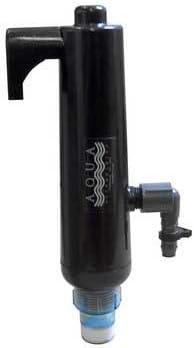
Shop UV sterilizers. This is the UV Sterilizer I Use To Help Control Algae
(I have one for each aquarium)
Tap for price.
FAQs – Removing Algae From Your Fish Tank
Question: My algae is still out of control. What else can I try?
Answer: You can use a phosphate remover or try commercial chemical treatments. Both options can help if you’re struggling to remove algae from a fish tank using natural methods.
Question: How do I know what type of algae I have in my aquarium?
Answer: Check out this algae identification guide: Freshwater Algae Types. Knowing the specific type makes it much easier to target and remove algae from a fish tank effectively.
Question: Is it safe to treat algae with chemicals if I have Marimo moss balls?
Answer: No. Always remove Marimo moss balls before applying chemical treatments. Place them in a separate container with aquarium water until after your next large water change. Then you can safely return them to the tank.
Question: Should I use a UV light (ultraviolet) to control algae in my fish tank?
Answer: Yes! I use UV lights in each of my aquariums, and they are highly effective at keeping algae under control.
Question: Is algae bad for my fish tank?
Answer: No, not at all. Every aquarium has algae, even those that are most cared for. It’s just unsightly and can kill the regular plants by growing on their leaves.
Question: How can I control algae in my aquarium?
Answer: This is how I control algae. 1) Add CO2 2) Plant heavily 3) Have the aquarium brightly lit but have the lights on no more than 6 hours a day. 4) Use reverse osmosis water.
My pick for Best On Ebay for "Live Fishfood":
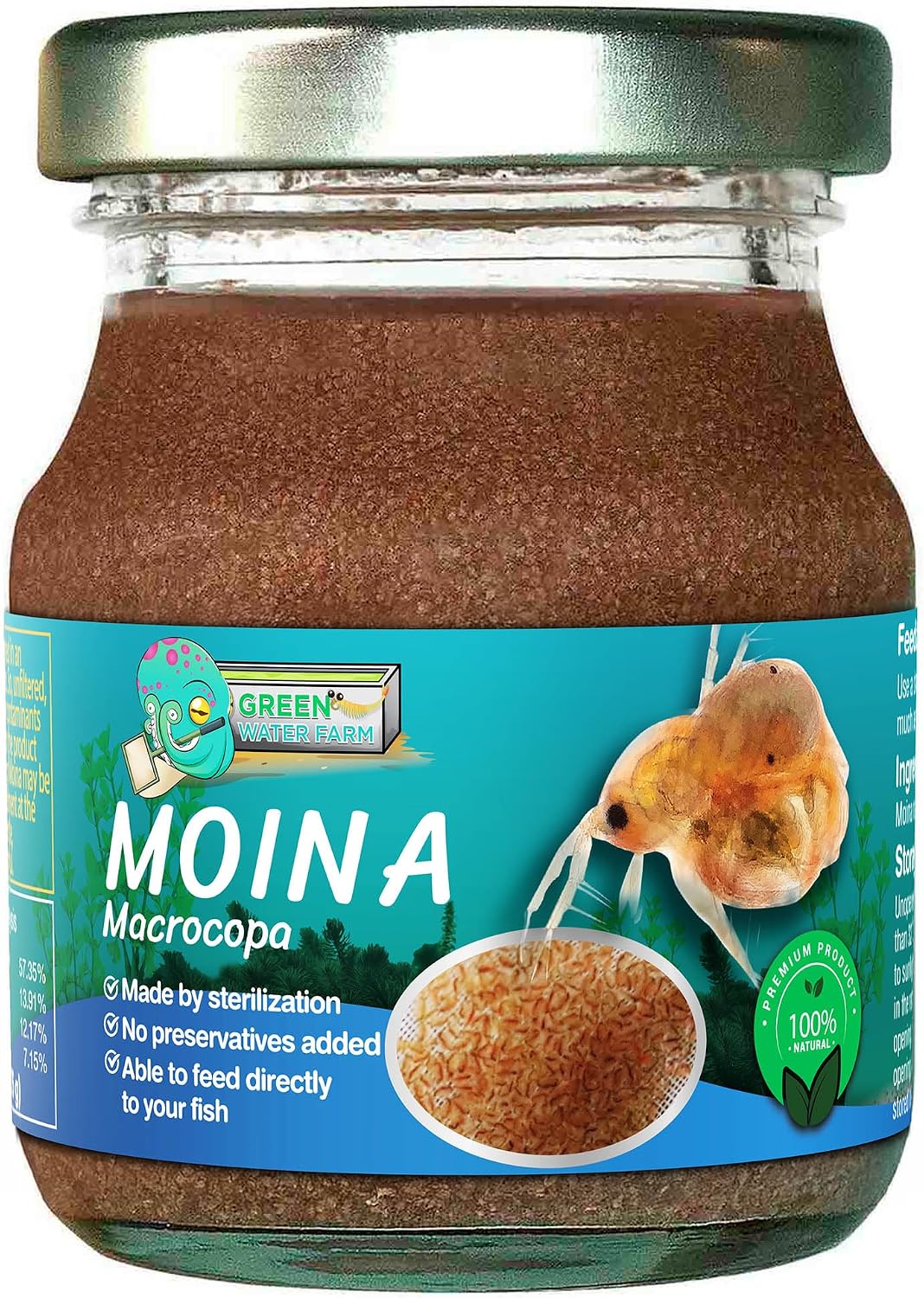
LIVE FISH FOOD: MOINA MACROCOPA (WATER FLEA)
Choice was based on:
⇒ The cost is excellent.
⇒ As close to live fish food as you can get
⇒ Seller has 54 reviews all 86% positive.
Tap this box to view current price
This post is a Reddit response to someone having algae issues in a planted tank. This is exactly what I would suggest for a heavily planted tank having algae issues. I have corrected grammar errors in the response.
Don
‘For scenarios like this, blackout is not an option. OP need to solve the root of the problem.
OP, please don’t abandon this project. This certainly can be hard to solve, but is gonna give you a lot of experience. Sadly, there is no magic recipe to solve thing like this. Each tank is a different world, so there is a lot of trial and error involved to reach the root of the problem.
For what I can see, there is too many plants blocking the surface, impeding proper light penetration in the tank. You can see that most of stem plants have a lot of space between leaves, especially at the right side of the tank. That’s a clear indicator of lack of light. At the left side of the tank you can see variations on the space between leaves, which could indicate that at some point there was changes in light intensity, which is not good, because we need stability in the tank.
What I would do in this case is remove all floaters and trim plants that are blocking the surface, this will allow good light penetration. As a direct effect of that, plants should grow faster, consuming more nutrients, leaving less nutrients available for algae growing. Also, I could trim and replant the top of plants that are too high. Trimming plants promote growing. We need growing plants. We want our plants to grow as fast as possible, so no nutrient is left behind for algae.
I don’t know exactly what nutrients routine are you are using, but for your plant’s symptoms, it seems like you are not using enough macro nutrients. The lack of macro nutrients can affect how plants process micro nutrients. As a result of that, plants can’t grow properly and, again, if they don’t grow and there is more nutrients left for algae.
As for your lights, I could try to reach at least 35/40 lumens per liter and set a period of 6 hours, with no ramp at the start or end. Ramps off light looks cool, but they don’t really help plants growing and are more beneficial for algae than plants.
With all of that established, you should start to see your plants growing and consuming nutrients in a steady way. That could be the first step to fight all of this algae. After that you need to keep your tank as stable as possible. Don’t go crazy with this problem. As I said, it can be difficult, but you are gonna learn a lot with this.’
I am losing my battle with algae for the second time. First time I completely started over, and now it’s happening again. I would appreciate some help!
byu/CinematicFigs inPlantedTank
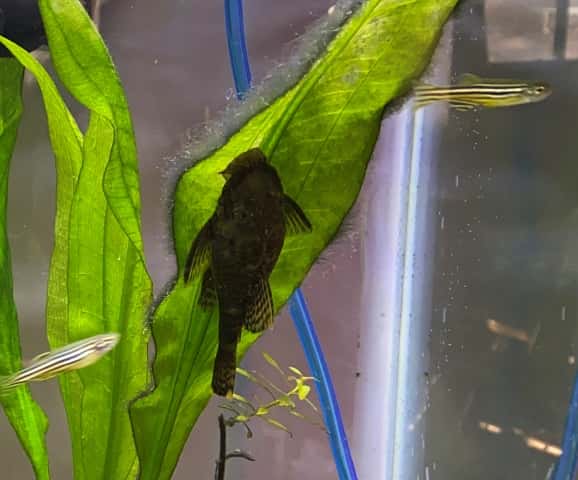
Image above: A sword in my aquarium. The sword plant has black beard algae growing on edges of the leaves. There is a female bristlenose pleco hanging off the underside of one of the sword plant leaves.
Other pages on this site:
⇒ 5 easiest fish for beginners
⇒ Planted aquarium without substrate
⇒ How to keep freshwater shrimp
⇒ 10 fast growing plants to help control algae in the planted aquarium
⇒ Taking photos of your aquarium using your smartphone
⇒ Aquarium Hobbyist Books & Gifts
⇒ My Top 3 Steps To Have Healthy Fish and A Healthy Aquarium


What’s a Natural, Low-Tech Planted Aquarium?


Image: Cleaning my 75-gallon when it’s still dark out.
